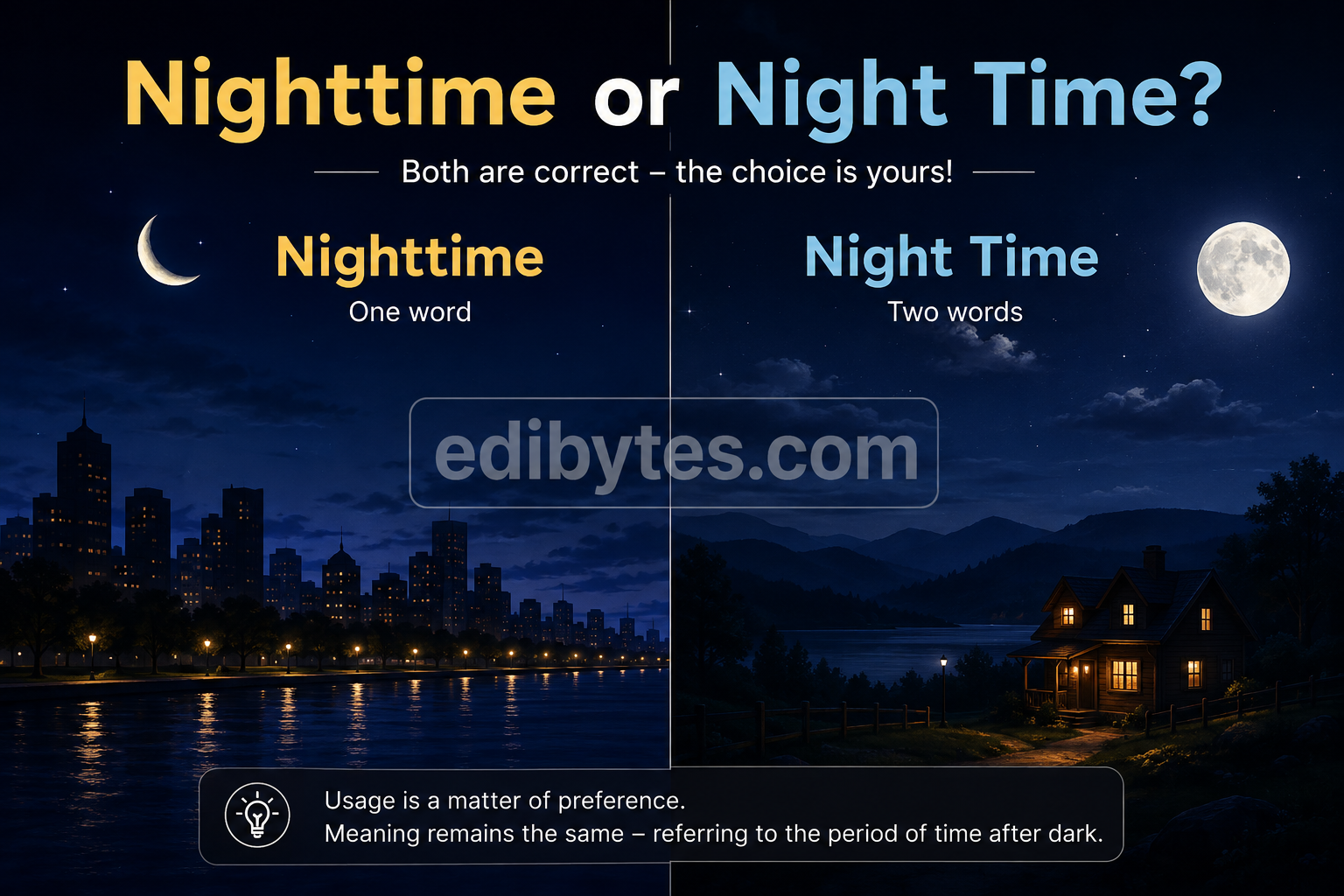
Quick answer: Both are technically fine, but “nighttime” is the safer, more modern choice for most writing, while “night time” is the old-school, more formal option that some style guides still prefer. Basically, nobody is wrong, but everybody has an opinion, and today we found the loudest one.
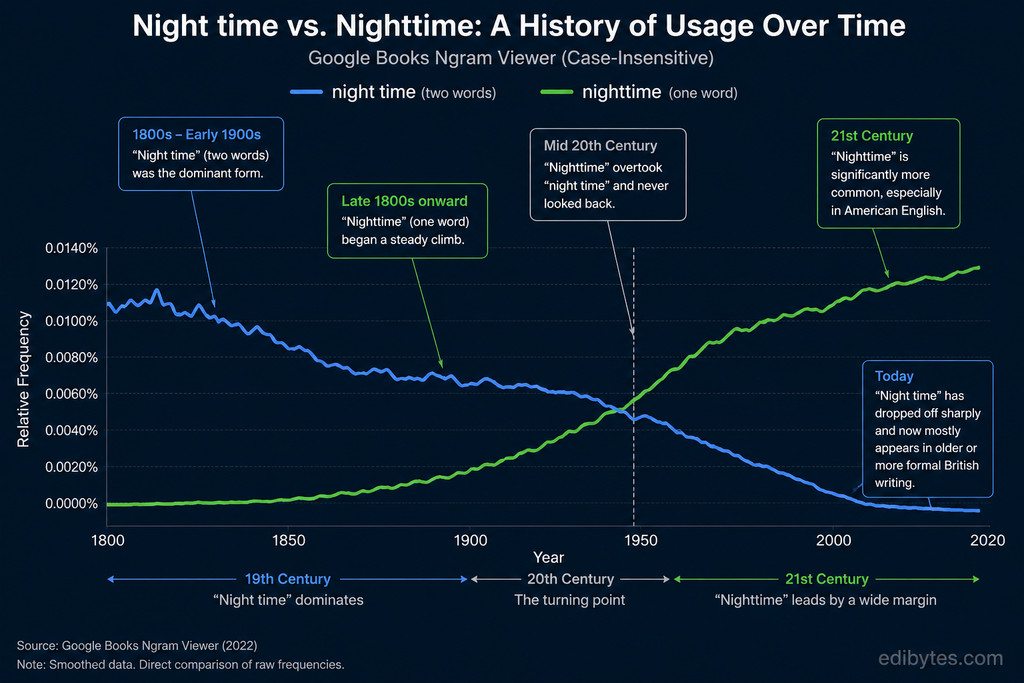
Usage History:
Key Takeaways
- “Nighttime” (one word) is now the more widely accepted form in modern American and British usage
- “Night time” (two words) isn’t wrong, it’s just older and a bit more formal
- Style guides disagree with each other constantly, so consistency matters more than “correctness”
- Grammar debates like this one exist mostly to give English teachers something to do at parties
- If you’re writing casually, pick one and move on with your life
Meet Mr. Alistair Finch. Thirty-two years teaching English literature and grammar at a school that shall remain nameless, mostly because he’s still bitter about their unofficial ban “for the children’s self-esteem.” He is, by his own admission, “a lot.” I sat down with him over tea he insisted on calling “elevenses” even though it was 4pm, to settle the age-old question: nighttime or night time?
Me: Alistair, thank you for doing this. Let’s just rip the bandage off. Nighttime or night time?
Oh, straight for the jugular, I love it. Look, both exist, both are used by intelligent people, and both have ruined at least one dinner party that I personally attended. “Nighttime” as one word is what most modern dictionaries and style guides lean toward now. “Night time” as two words used to be the standard and honestly still shows up plenty, especially in British English and older texts. So the boring truthful answer is: neither of them will get you arrested.
Me: That’s shockingly reasonable for a man who once stopped a wedding.
I contain multitudes.
Me: Fair. So why does this even come up? Why do people care?
Because English is a language built by committee, if the committee were drunk and constantly changing its mind. We used to write “to-day” with a hyphen. Nobody blinks at “today” now. Compound words go through phases. First they’re two separate words, then somebody gets impatient and hyphenates them, and eventually the hyphen gets bored and leaves too, and you’re left with one solid word. “Nighttime” is just further along in that journey than some people are comfortable with.
Me: So it’s basically a linguistic teenager going through changes.
Exactly. Puberty, but for compound nouns.
Me: You mentioned dinner parties. Personal experience time. What happened?
Right, so I was at a friend’s house, lovely evening, and someone said “we should do a night time drive to see the stars,” and I, completely unprompted, said “you mean nighttime, one word, like a grown adult in the 21st century.” The table went silent. My friend’s aunt, who taught grammar school for forty years, looked me dead in the eye and said “it’s two words, Alistair, and it always has been.” We did not speak for the rest of dinner. I left with a strong sense of righteousness and absolutely no dessert.
Me: Did you look it up when you got home?
Immediately. And here’s the humiliating part, we were both sort of right, which is somehow worse than being wrong. Most current dictionaries list “nighttime” as the primary form. But plenty of respected style guides, especially older or British ones, still treat “night time” as perfectly standard, particularly when it’s being used more descriptively, like “night time is when the crickets come out” versus “he works the nighttime shift.”
Me: So there’s an actual grammatical distinction hiding in there?
Sort of, if you squint. When it’s functioning as a noun on its own, like “night time” describing the general concept of it being nighttime, some purists prefer two words. When it’s acting like an adjective, like “nighttime routine” or “nighttime driving,” one word feels more natural to most people now. But honestly, this distinction is the kind of thing that matters to about eleven people on the planet, and I am one of them, tragically.
Me: Let’s do some rapid fire questions from readers. First one: is “nite” ever acceptable?
Only if you are a diner sign from 1974 or you enjoy disappointing your mother.
Me: Is this the same debate as “everyday” versus “every day”?
Cousins, not twins. Same family of problems though. “Everyday” is an adjective, like “an everyday occurrence.” “Every day” means each individual day, like “I regret my dinner party comment every day.” See what I did there.
Me: I did. Next one, does British English versus American English actually matter here?
A little. British writing tends to hold onto “night time” as two words a bit longer and more formally than American writing does. Americans, being Americans, got impatient and smushed it together faster. This tracks with basically every other stylistic difference between the two.
Me: Should people just pick one and be consistent?
Yes. A thousand times yes. This is the actual advice, not the party trick advice. Pick nighttime or night time, and then use it the same way throughout whatever you’re writing. Consistency is what editors actually care about. Nobody is losing sleep, pun intended, over which one you picked, as long as you don’t switch back and forth like you’re negotiating a hostage situation with yourself.
Me: Last one. If someone corrects you on this at a dinner party, what should they say?
Smile, nod, and quietly note that the person correcting them once ruined a wedding over identical stakes. Then order dessert before anyone can stop them.
Me: Alistair, this has been genuinely delightful. Any final thoughts?
Only that language is alive, it argues with itself constantly, and the fact that we can spend this much energy on whether a word needs a space in it is honestly one of the more charming things about being human. Also, nighttime, one word, is winning. Slowly. But it’s winning.
And there you have it. The nighttime versus night time debate, settled by a man who has personally suffered for his opinions on it. Use whichever one you like. Just don’t bring it up at a wedding.