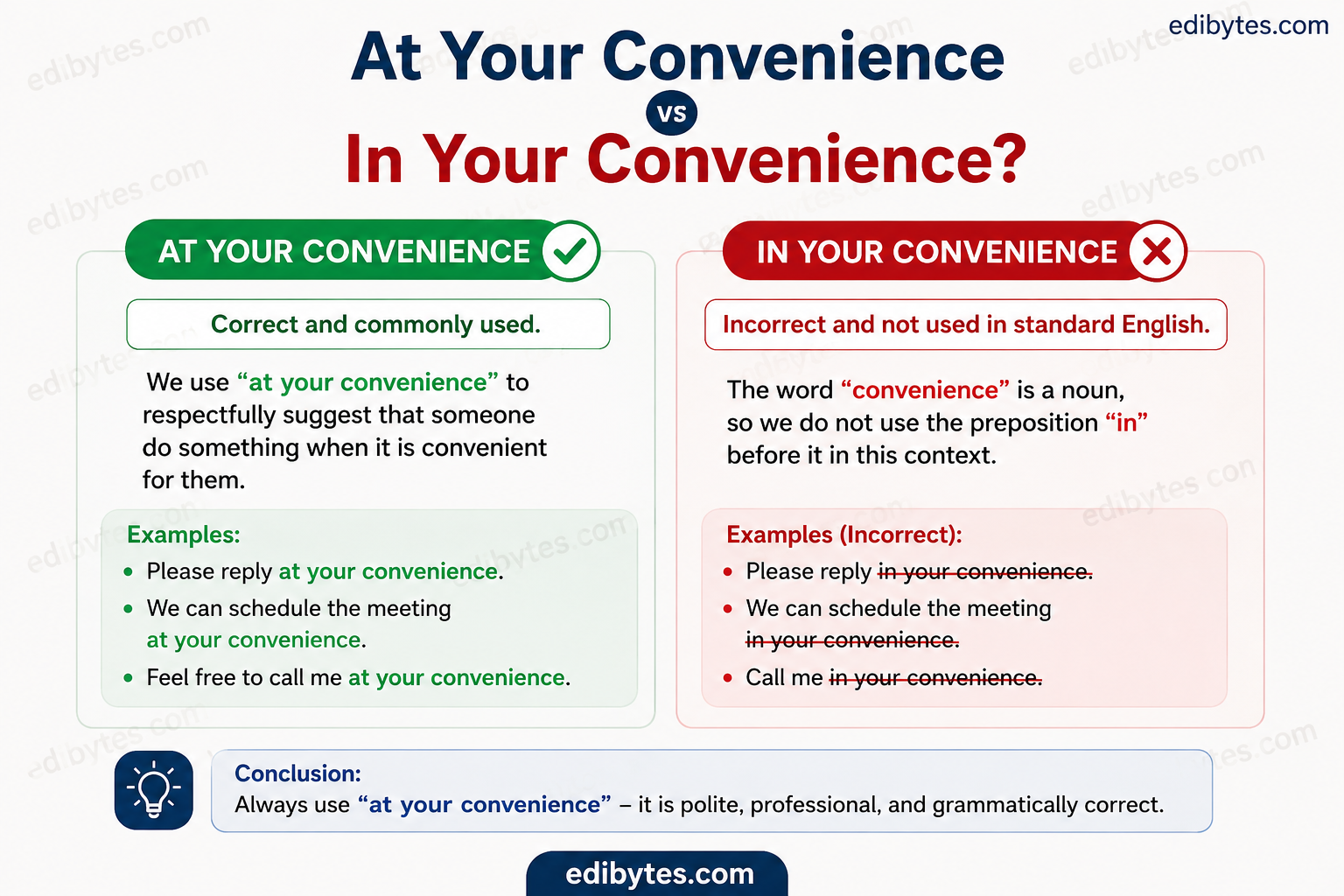
It’s “at your convenience.” “In your convenience” is not standard English, no matter how confidently your coworker’s email signature insists otherwise.
Key Takeaways
- “At your convenience” is the correct, idiomatic phrase. It means “whenever it suits you” or “whenever is easiest for you.”
- “In your convenience” is a common mistake, usually made by non-native speakers translating the phrase directly from another language.
- The word “convenience” pairs with the preposition “at” in this expression, the same way we say “at your leisure” or “at your discretion.”
- The meaning does not change between the two. Only one of them is actually correct.
- This rule holds true in both American and British English.
Now, since a plain grammar rule can get a little dry, I sat down with someone who has spent thirty years correcting this exact mistake on whiteboards, in margins, and once, famously, on a wedding invitation. Meet Mr. Nigel Fussington, semi-retired English teacher, self-appointed “Guardian of the Preposition,” and a man who still gets a physical reaction when he sees “in your convenience” typed out loud.
The Interview
Me: Mr. Fussington, thank you for making time for this.
Nigel Fussington: At my convenience, I hope, not in it. Let’s start as we mean to go on.
Me: Fair enough. Let’s just get straight to it then. Is it “at your convenience” or “in your convenience”?
Fussington: It’s “at your convenience.” Full stop. I’ve been teaching English for three decades and I have never, not once, opened a proper dictionary and found “in your convenience” sitting there smiling back at me. It doesn’t exist. It’s a grammatical ghost. People see it, but it was never actually there.
Me: So where does “in your convenience” even come from?
Fussington: Mostly translation habits. In a lot of languages, the equivalent phrase for “at a time that suits you” uses a word that translates more naturally to “in.” So people carry that structure over into English, and out pops “in your convenience.” It’s an understandable mistake. It is still a mistake.
What Does “Convenience” Actually Mean Here?
Me: Let’s back up a step. What does “convenience” mean in this phrase specifically?
Fussington: “Convenience” is a noun. It means suitability, ease, or a lack of trouble. When someone says “at your convenience,” they’re saying “whenever it’s easy for you” or “whenever suits your schedule.” Nobody is asking you to do anything right this second. It’s a polite way of handing someone control over timing.
Me: And that’s different from other uses of “convenience,” like “convenience store”?
Fussington: Correct. “Convenience store” uses convenience as a modifier describing a type of shop, one built around ease of access. In “at your convenience,” convenience is the object of the preposition “at.” Same word, different job in the sentence.
The Grammar Rule Behind the Difference
Me: So what’s actually happening grammatically here? Why “at” and not “in”?
Fussington: This comes down to something linguists call fixed prepositional collocations. Certain nouns simply pair with certain prepositions by convention, not by logic. You don’t choose the preposition because it makes the most literal sense. You choose it because that’s the preposition English speakers have agreed to use with that word, over generations of use.
Think about it this way. We say “at your leisure,” “at your discretion,” “at your earliest convenience,” and “at will.” We don’t say “in your leisure” or “in your discretion.” “Convenience” simply lives in the “at” family of expressions when we’re talking about timing and personal choice.
Me: Is there a rule that predicts which preposition a word will use?
Fussington: Not a reliable one, no. This is one of the more frustrating truths about English. Prepositions attached to abstract nouns like this are largely learned through exposure, not logic. Native speakers absorb “at your convenience” through years of hearing it. Learners have to memorize it as a set phrase, because trying to reason your way to the “correct” preposition from first principles usually leads you straight to a mistake.
What Do Dictionaries and Style Guides Say?
Me: Does this hold up if we check the actual references?
Fussington: It does. Standard dictionaries such as Merriam-Webster and Cambridge Dictionary list “at your convenience” (or the closely related “at your earliest convenience”) as an established idiomatic expression meaning “at a time that suits you.” You will not find “in your convenience” listed as an accepted variant in any major English dictionary or usage guide, because it isn’t one. It’s not a matter of formal versus informal, or American versus British. It’s simply not part of standard English.
Me: Do style guides like Chicago or AP weigh in on this specifically?
Fussington: Not directly, because this isn’t really a style question, it’s a usage question. Style guides tend to focus on punctuation, capitalization, and citation formatting rather than individual prepositional idioms. But general usage guides and dictionaries agree unanimously here. When sources disagree on a grammar point, I’ll tell you. This isn’t one of those cases.
Has “In Your Convenience” Always Been Wrong?
Me: Is there any history here? Did “in your convenience” ever have a moment where it was acceptable?
Fussington: Not that reliable sources support. “At your convenience” has a long, well-documented history as a polite formula in English correspondence, particularly in business and formal writing, where it softened requests and gave the other person control over timing. “In your convenience” doesn’t have a comparable historical footing as a standard phrase. It shows up as an error, consistently, rather than as an older accepted form that fell out of fashion. That’s an important distinction. Some “incorrect” phrases are actually old correct ones nobody uses anymore. This isn’t one of those. It’s simply a persistent slip.
Does American or British English Treat This Differently?
Me: What about regional differences? Do Americans and Brits disagree here?
Fussington: They don’t, and that alone should tell you something. When there’s a genuine American versus British split, you’ll usually find it clearly documented, the way “favor” and “favour” are. Here, both varieties of English use “at your convenience” identically, in the same contexts, with the same meaning. “In your convenience” isn’t standard in American English, and it isn’t standard in British English either. It’s not regional. It’s simply not correct English.
How “At Your Convenience” Works in a Sentence
Me: Can you walk through how this phrase actually functions grammatically?
Fussington: Gladly. “At your convenience” works as an adverbial phrase, meaning it modifies a verb by describing when or how an action should happen.
As a closing line in an email:
- “Please send the documents at your convenience.”
- “Feel free to call me back at your convenience.”
As part of a request:
- “Could you review this contract at your convenience?”
- “We’d like to schedule a call at your convenience.”
There’s also the extended version, “at your earliest convenience,” which means “as soon as reasonably possible for you.” It’s slightly more urgent while still remaining polite.
- “Please respond at your earliest convenience.”
You’ll notice the phrase almost always follows a request or an invitation. It rarely stands alone.
Common Mistakes People Make
Me: Let’s talk mistakes. What are the ones you see constantly?
Fussington: Three, mainly.
Mistake #1: Swapping “at” for “in.” This is the headline mistake. “In your convenience” happens because writers assume prepositions are interchangeable, or because they’re translating from a language where the equivalent phrase uses “in.” The fix is simple memorization: convenience takes “at” in this expression.
Mistake #2: Dropping “your” entirely. Some writers shorten it to “at convenience,” which sounds clipped and slightly off in formal writing. The possessive matters here. “At your convenience” specifies whose schedule is being respected.
Mistake #3: Overusing “at your earliest convenience” when it isn’t urgent. This phrase actually signals mild urgency. Using it for something genuinely unimportant can come across as passive aggressive rather than polite. If there’s no real deadline, plain “at your convenience” is friendlier.
Real-World Examples
Me: Give me some real usage. How does this show up outside a grammar lesson?
Fussington: In everyday conversation, you’ll hear it in casual scheduling.
- “Swing by at your convenience, no rush.”
- “Pick a time that works at your convenience.”
In professional writing, it’s practically a fixture of polite business correspondence.
- “Attached is the report for your review. Please let me know your feedback at your convenience.”
- “We would appreciate it if you could complete the form at your convenience.”
Here’s a better versus worse comparison.
Worse: “Please review this in your convenience and reply.” Better: “Please review this at your convenience and reply.”
The second version reads naturally to any fluent speaker. The first stops a reader in their tracks, which is the last thing you want in a professional email.
Practical Guidelines for Getting It Right
Me: Any quick rules for people who don’t want to think about grammar theory every time they write an email?
Fussington: A few.
Quick rules to remember:
- Convenience pairs with “at,” not “in.” Memorize the pair, not the logic.
- If you’re tempted to write “in your convenience,” swap it for “at your convenience” before you hit send.
- Use “at your earliest convenience” only when there’s genuine mild urgency.
A quick checklist before you send that email:
- Did I write “at” and not “in” before “your convenience”?
- Is “your” included, rather than a bare “at convenience”?
- If I used “earliest,” is there actually some time pressure involved?
- Does the sentence still make sense if I mentally replace the phrase with “whenever suits you”?
If everything checks out, you’re clear.
Wrap-Up
Me: Any final thoughts before we wrap this up?
Fussington: Just one. English is full of phrases where the “correct” preposition isn’t something you can reason your way into, you simply have to know it. “At your convenience” is one of those. It’s not about logic. It’s about convention, and the convention has been settled for a very long time.
Your simple rule: If you remember only one thing, remember that convenience travels with “at,” never “in.” Say it with me: at your convenience.
Frequently Asked Questions
Is “at your convenience” or “in your convenience” correct? “At your convenience” is correct. “In your convenience” is not standard English and isn’t listed in major dictionaries as an accepted phrase.
Why do people write “in your convenience” if it’s wrong? It’s usually the result of direct translation from another language where the equivalent expression uses a word closer to “in” rather than “at.”
Does “in your convenience” ever change the meaning? No. It’s simply an incorrect version of the same intended meaning, not an alternate phrase with its own distinct sense.
Is “at your convenience” formal or informal? It works in both. It’s common in professional emails and business writing, but it’s also perfectly natural in casual conversation when arranging plans.
Is one form preferred in American English versus British English? No. “At your convenience” is standard in both American and British English, with no regional split.
What’s the difference between “at your convenience” and “at your earliest convenience”? “At your convenience” simply means whenever suits you, with no urgency implied. “At your earliest convenience” adds a note of mild urgency, meaning as soon as reasonably possible.
Which form should I use in professional writing? Always use “at your convenience” (or “at your earliest convenience” if there’s real time sensitivity). “In your convenience” will read as an error to any fluent reader.
Conclusion
The answer hasn’t moved an inch since the start of this interview: it’s “at your convenience,” not “in your convenience.” Convenience is one of those English nouns that simply insists on pairing with “at,” the same way “leisure” and “discretion” do, and no amount of logical reasoning will talk it into accepting “in” instead. The meaning stays the same either way, whenever it’s easy for the other person, but only one version of the phrase is actually recognized as correct English. Whether you’re closing a business email or texting a friend about weekend plans, stick with “at your convenience,” and you’ll never give Mr. Fussington a reason to sigh.