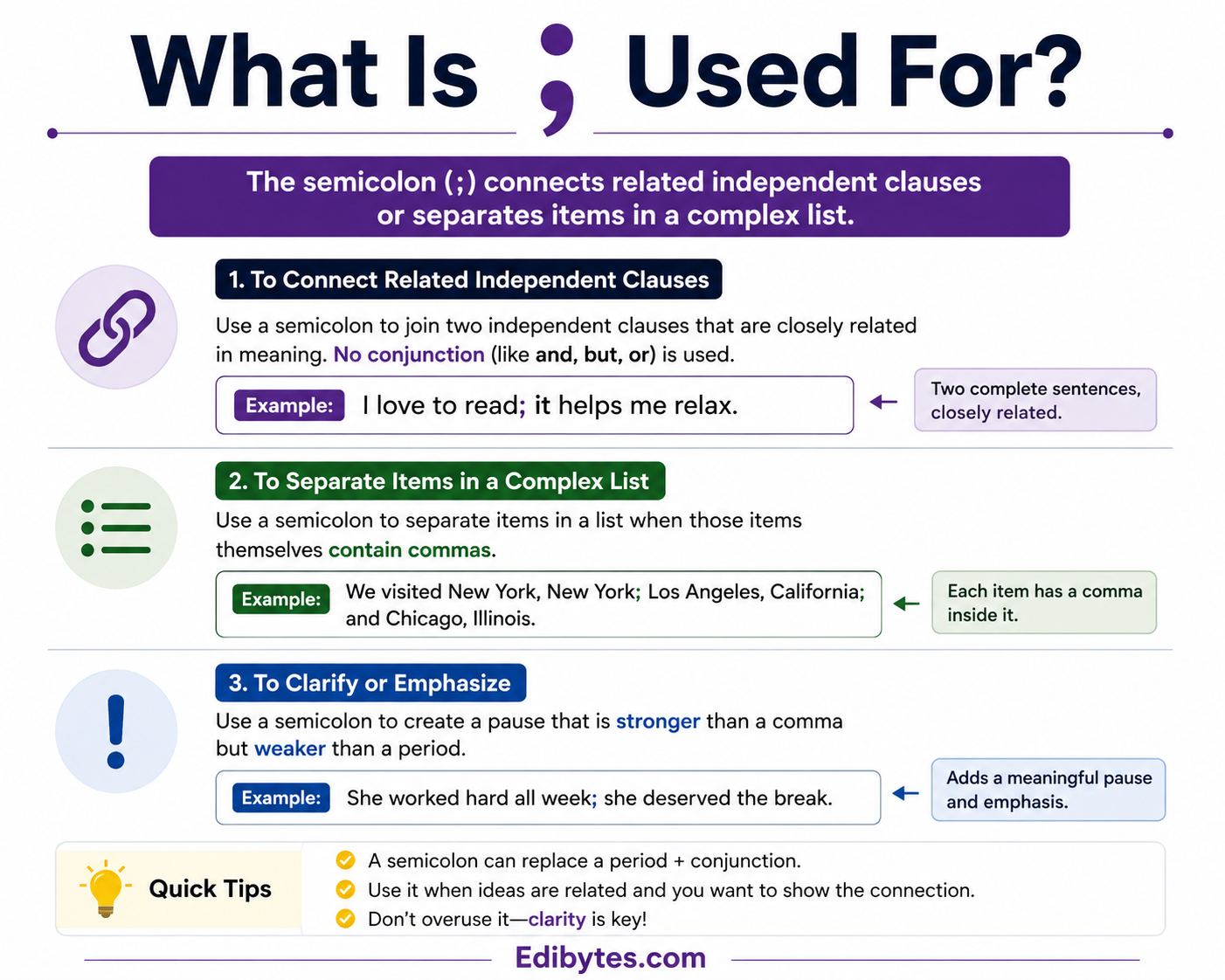
A semicolon (;) is mainly used to connect two closely related independent clauses without using a conjunction like and, but, or so.
For example:
I wanted to go to bed early; the internet had other plans.
Both parts could be complete sentences:
I wanted to go to bed early.
The internet had other plans.
The semicolon basically looks at those two sentences and says, “You two clearly have chemistry. Stay together.”
It is also used to separate complicated items in a list, especially when the items already contain commas.
For example:
Our guests included John, a teacher from California; Sarah, a lawyer from New York; and Dave, a man who still thinks replying “K” is a complete emotional response.
That is the short answer. Unfortunately, the semicolon has spent centuries being misunderstood, avoided, misused, and occasionally inserted into sentences by people who just wanted to look expensive.
So we spoke to Rick Mott, PhD, a reputed English teacher, grammarian, and the kind of man who allegedly notices incorrect apostrophes while ordering coffee.
Key takeaways
- A semicolon connects two complete and closely related sentences.
- It can replace a full stop when you want the ideas to feel more connected.
- It can also separate complicated items in a list.
- You generally should not use it between a sentence and a fragment.
- You definitely do not need to put one into a sentence just because you have recently discovered the semicolon key on your keyboard.
- If you’re unsure, a full stop is usually safer; nobody has ever been arrested for using one.
Interview: What Exactly Is a Semicolon Doing in My Life?
Interviewer: Rick Mott, PhD, let’s start with the question that has brought millions of confused people to Google. What is a semicolon used for?
Rick Mott: Its primary job is to connect two independent clauses that are closely related.
Let me put that in normal human language.
If you have two sentences that can stand on their own, but they are talking about the same situation, you can join them with a semicolon.
For example:
I studied grammar for three hours; I still put “your” instead of “you’re.”
Both sides are complete sentences. The semicolon joins them because the second part is directly connected to the first.
It is basically stronger than a comma but less emotionally distant than a full stop.
Interviewer: So it’s like a punctuation mark that doesn’t want the relationship to end?
Rick Mott: Precisely. A full stop says, “We’re done here.”
A semicolon says, “I have finished my sentence; however, I would like you to remain in the room.”
The Personal Experience Section, Because Apparently I Have History With This
Interviewer: Sachin, what has been your personal experience with the semicolon?
Sachin: Honestly, I think most people first see a semicolon and immediately assume it belongs to someone smarter.
You see a sentence like:
The meeting was supposed to start at 10; nobody arrived until 10:45.
And suddenly you’re thinking, “Wow. This person probably owns leather-bound books.”
But then you try to use one yourself and spend ten minutes wondering whether the comma was safer.
My personal strategy for years was simple: avoid semicolons completely. If a sentence became too complicated, I would either use a full stop or rewrite the whole thing and hope nobody noticed.
Rick Mott, PhD: That is actually a better strategy than randomly throwing semicolons around.
Sachin: Thank you. I have finally received academic validation for being scared of punctuation.
So When Can I Actually Use a Semicolon?
Interviewer: Give us the easiest rule possible.
Rick Mott: Here it is.
Use a semicolon when:
- The part before it is a complete sentence.
- The part after it is also a complete sentence.
- The two ideas are closely connected.
For example:
Google changed something again; SEOs immediately opened seventeen tabs.
Both sides work independently:
Google changed something again.
SEOs immediately opened seventeen tabs.
The semicolon simply tells the reader that these two ideas belong together.
Interviewer: What if the second part isn’t a complete sentence?
Rick Mott, PhD: Then the semicolon should probably stay in its drawer.
Incorrect:
I went to the store; because I needed milk.
“Because I needed milk” is not an independent sentence. It depends on the first part.
Correct:
I went to the store because I needed milk.
Or:
I needed milk; therefore, I went to the store.
Although I should warn everyone that using “therefore” too often can make you sound like a Victorian lawyer explaining why someone stole a goat.
Can a Semicolon Replace a Comma?
Interviewer: This is where people really start pressing random keys.
Rick Mott, PhD: A semicolon is not just a comma with better career prospects.
A comma is often used inside a sentence to separate parts. A semicolon has a different job.
For example, this is wrong:
I woke up; drank coffee; checked my phone.
Those are not three independent clauses in the way required here.
You could simply write:
I woke up, drank coffee, and checked my phone.
Or:
I woke up. I drank coffee. I checked my phone.
Sachin: Basically, don’t use a semicolon every time you feel a sentence needs more personality.
Rick Mott, PhD: Exactly. Punctuation is not seasoning.
You cannot keep adding semicolons until the sentence tastes sophisticated.
What About Using a Semicolon in a List?
Interviewer: Ah yes, the second job of the semicolon.
Rick Mott, PhD: This is actually a very useful one.
Imagine you are writing a list, but every item in that list already contains commas.
For example:
I have lived in USA; visited Dubai, UAE; and spent far too much time online.
The semicolons make it easier to see where one major item ends and another begins.
A more complicated example:
The panel included Ravi Sharma, an SEO consultant from CALIFORNIA; Emily Brown, a content editor from London; and Mark Wilson, a developer who had already asked when the meeting would end.
If you used only commas, the reader might need a map.
Sachin: So the semicolon is basically traffic control.
Rick Mott, PhD: That’s surprisingly accurate.
Can I Use a Semicolon Before “However”?
Interviewer: This is where people either become grammar experts or start crying.
Rick Mott, PhD: You can use a semicolon before words such as however, therefore, nevertheless, and moreover when they connect two complete clauses.
For example:
I planned to finish the article early; however, I spent an hour researching whether pigeons recognize themselves in mirrors.
Both sides are complete sentences.
The standard structure is:
Independent clause; however, independent clause.
Sachin: And if I write, “I wanted to finish early; however tired,” I assume that is nonsense?
Rick Mott, PhD: It is not a semicolon problem at that point. It is a cry for help.
Why Do People Avoid Semicolons?
Interviewer: Honestly, why don’t we just use full stops and move on with our lives?
Rick Mott, PhD: You absolutely can.
The semicolon is useful, but it is not mandatory. English writing will survive without one.
Many people avoid it because they aren’t entirely sure when to use it. Others use it too much because they have just learned when to use it.
Both groups eventually find balance.
Sachin: I think there are two kinds of writers.
The first type sees a semicolon and thinks, “Absolutely not.”
The second type learns what it does and suddenly writes:
I woke up; I showered; I ate breakfast; I checked my phone; I questioned my existence.
And then wonders why the paragraph looks like a fence.
Rick Mott, PhD: That is an excellent description of the semicolon learning curve.
Is a Semicolon Stronger Than a Comma?
Interviewer: Settle this once and for all.
Rick Mott, PhD: Yes, in a sense.
Think of punctuation as different levels of separation.
A comma suggests a lighter pause.
A semicolon creates a stronger break while keeping the ideas connected.
A full stop separates them completely.
So:
I was tired, but I kept working.
The comma works because “but” is connecting the clauses.
Or:
I was tired; I kept working.
The semicolon connects the two complete ideas without needing “but.”
Or:
I was tired. I kept working.
Now the two statements stand separately.
Sachin: So the semicolon is the middle option for people who cannot decide whether to break up the sentence.
Rick Mott, PhD: I have spent forty years teaching English, and unfortunately, yes.
What Is the Biggest Semicolon Mistake?
Interviewer: What makes you want to gently close your grammar book and walk away?
Rick Mott, PhD: Using a semicolon where a colon or comma should be.
For example:
My favorite things are; coffee, sleep, and avoiding meetings.
Incorrect.
You would normally write:
My favorite things are: coffee, sleep, and avoiding meetings.
The colon introduces the list.
The semicolon is not there to announce something. It has other responsibilities.
Sachin: The semicolon already has enough on its plate.
Rick Mott, PhD: Exactly. Stop giving it extra work.
Can You Give Us a Quick Semicolon Cheat Sheet?
Interviewer: Something people can remember without opening a 700-page grammar textbook?
Rick Mott, PhD: Certainly.
Use a semicolon when joining two related complete sentences:
I missed the bus; I had to walk.
Use it to separate complicated list items:
We visited Paris, France; Rome, Italy; and Madrid, Spain.
Do not use it before a fragment:
Incorrect:
I stayed home; because it was raining.
Correct:
I stayed home because it was raining.
Do not use it randomly instead of a comma:
Incorrect:
I bought bread; milk; and eggs.
Correct:
I bought bread, milk, and eggs.
Sachin: That’s actually much simpler than the semicolon’s reputation.
Rick Mott, PhD: Most grammar rules are.
The real problem is that punctuation marks have terrible public relations.
Final Question: Should People Use Semicolons More Often?
Interviewer: Rick Mott, PhD, should we all start using semicolons immediately?
Rick Mott, PhD: No.
Use one when it helps the sentence.
Do not use one because you think it makes you sound intelligent.
Good writing is not a competition to see how many punctuation marks you can deploy before lunch.
Sachin: That might be the most important lesson here.
For me, the semicolon used to feel like one of those things that English teachers knew about but ordinary people were not supposed to touch.
Now I see it differently.
It is just a useful tool.
You have two complete thoughts. They are closely related. You don’t want a full stop. You don’t want to use “and” or “but.”
That is when the semicolon walks into the room and says:
Relax; I’ve got this.
And honestly, that is probably all you need to remember.
The final answer
A semicolon (;) is used to join two closely related complete sentences or to separate complicated items in a list.
That’s it.
You can now return to writing with confidence; or, if you’re like most people, continue using full stops and commas while pretending the semicolon doesn’t exist.