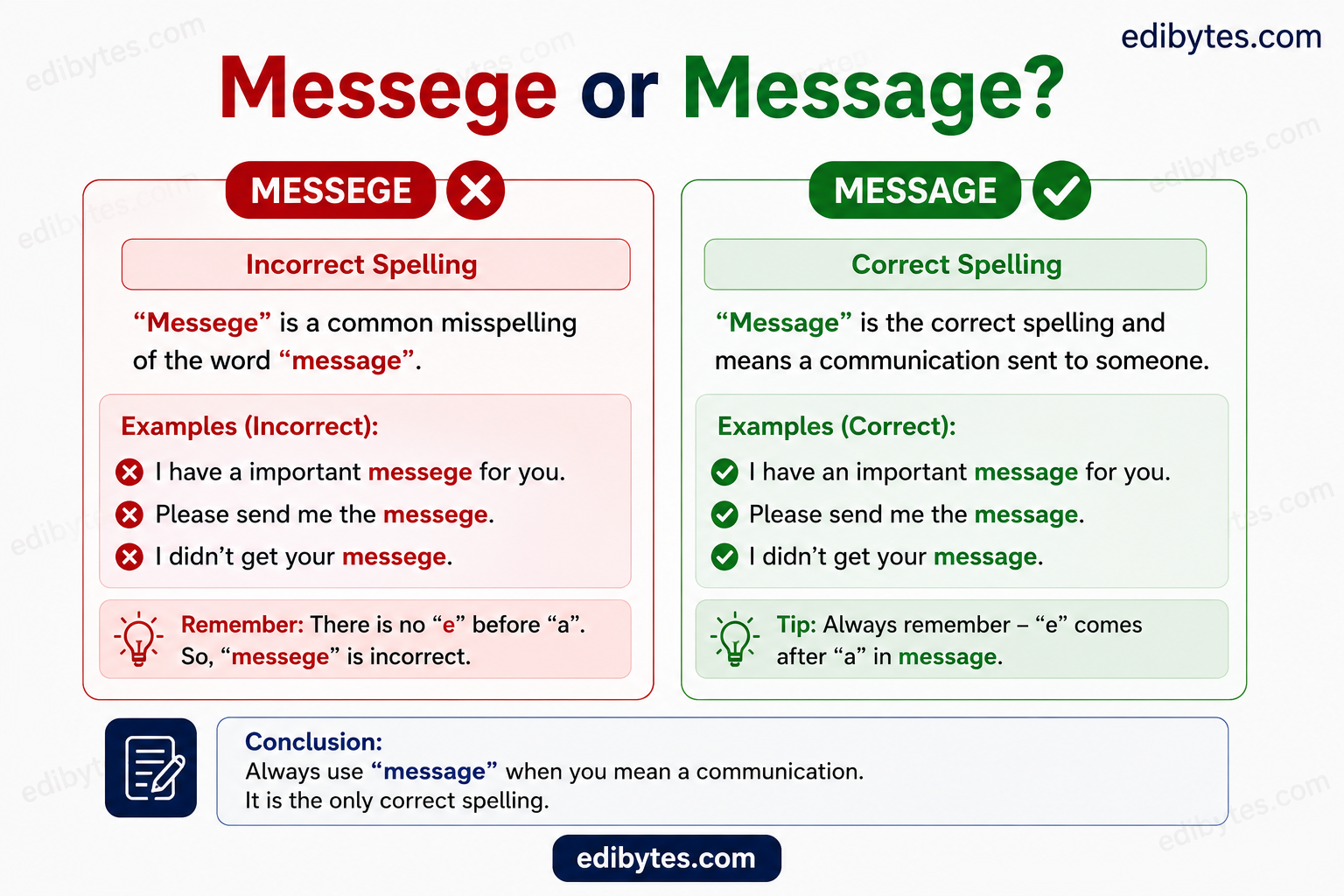
“Message” is correct. “Messege” is not a word. It never was. It’s simply a misspelling that keeps sneaking into texts, emails, and comment sections like a raccoon that’s figured out the trash can lid.
We sat down with veteran English teacher Mr. Barnaby Fitchett, who has spent 31 years grading essays, correcting group chats he wasn’t even part of. He agreed to answer the internet’s most pressing spelling question, mostly because we bribed him with a decent cup of tea.
Key Takeaways
- “Message” is the only correct spelling. “Messege” is a common typo, not an alternate form.
- The mistake usually happens because people mishear or misremember the second vowel sound.
- Both spellings sound identical when spoken, which is exactly why the error spreads so easily in writing.
- “Message” works as both a noun and a verb (“send a message” / “message me later”).
- There is no regional variation here. American English and British English agree: it’s “message,” full stop.
The Interview Begins
Us: Mr. Fitchett, thank you for joining us. Let’s get right to it. Messege or message?
Mr. Fitchett: Message. Always message. I want to be very clear before we go any further, because I know some readers will scroll straight to the comments to argue with me. There is no world, no dialect, no ancient forgotten manuscript, where “messege” is correct. It’s a typo wearing a word costume.
Us: Strong opening. But why does this typo happen so often?
Mr. Fitchett: Because English loves to torment us with vowels that all sound suspiciously similar when you’re typing fast on a phone with your thumbs and your dignity. Say “message” out loud. The second syllable is a soft, mushy “ij” sound. Your brain doesn’t hear a crisp A, so some people guess and land on E instead. It’s an honest mistake. I’ve made worse ones, usually involving “definitely.”
What “Message” Actually Means
Us: Let’s back up. What does “message” mean, plainly?
Mr. Fitchett: As a noun, a message is a piece of information sent from one person to another, spoken, written, or typed. A note left on the fridge. A text saying “running late.” A speech with a deeper meaning, as in “the film had a strong message.” As a verb, to message someone means to send them that piece of information, usually electronically these days. “I’ll message you tomorrow.”
Us: So it does double duty.
Mr. Fitchett: It does. Noun and verb, same spelling, no drama. Some words in English insist on changing form depending on the job they’re doing. “Message” isn’t one of the difficult ones. It just wants you to spell it right.
The Real Reason People Misspell It
Us: Is there an actual grammar rule behind this, or is it purely a spelling issue?
Mr. Fitchett: Purely spelling, and I say that with relief, because spelling errors are far easier to fix than grammar disasters. This isn’t a case of two legitimate forms competing, like “toward” versus “towards.” It’s one correct spelling and one incorrect one that people type because it sounds plausible. Think of it like calling someone “expresso” instead of “espresso.” The wrong version has been repeated so often it starts to feel familiar, even though it never earned that familiarity honestly.
Us: So “messege” is basically espresso’s typo cousin.
Mr. Fitchett: Beautifully put. I’m stealing that for my next class.
What the Dictionaries Say
Us: What do the major dictionaries say about this?
Mr. Fitchett: They agree, which almost never happens, so treasure it. Merriam-Webster lists “message” as the standard spelling for both the noun and verb forms. Cambridge Dictionary does the same, defining it as a piece of written, verbal, or recorded communication. Collins Dictionary and the Oxford English Dictionary also list only “message,” with no acknowledgment of “messege” as a variant spelling anywhere. Style guides like the Chicago Manual of Style and the AP Stylebook don’t even bother addressing it directly, because it isn’t a stylistic choice. It’s simply incorrect.
Us: No disagreement among the sources at all?
Mr. Fitchett: None. When I tell my students that dictionaries argue about things like “toward” versus “towards,” or whether “email” needs a hyphen, their eyes light up because they smell chaos. This is not one of those moments. I’m sorry to disappoint the chaos fans.
Where “Message” Comes From
Us: Any interesting history behind the word?
Mr. Fitchett: It traces back to Old French “message,” which itself came from Medieval Latin “missaticum,” related to “mittere,” meaning to send. The word has carried the same core idea for centuries: something sent from one person to another. English borrowed the French spelling essentially as is, which is part of why the “a” survived instead of drifting toward an “e.” “Messege” was never a historical or regional spelling. It’s a modern typo, not a fossil.
American English vs. British English
Us: Any differences between American and British usage?
Mr. Fitchett: None worth mentioning. Both varieties spell it “message,” use it as a noun and verb the same way, and would equally raise an eyebrow at “messege.” This is one of the rare spelling questions where an American teacher and a British teacher can sit in the same room and agree on everything, which honestly might be the most surprising part of this whole interview.
How “Message” Works in a Sentence
Us: Can you walk us through how it functions grammatically?
Mr. Fitchett: Gladly.
As a noun:
- “I left you a message on the kitchen table.”
- “The novel’s message is about resilience.”
- “Did you get my message?”
As a verb:
- “Message me when you land.”
- “She messaged the whole group at once.”
- “He’s been messaging me since Tuesday.”
Common collocations:
- “Send a message,” “leave a message,” “get the message,” “text message,” “voice message,” “direct message.”
Us: Any of those change if someone spells it wrong?
Mr. Fitchett: The grammar stays intact. Only the spelling embarrasses you.
Common Mistakes
Mistake #1: Writing “messege” instead of “message” This is the classic version of the error, usually caused by guessing at the vowel sound rather than recalling the spelling. Wrong: “I sent you a messege.” Correct: “I sent you a message.”
Mistake #2: Writing “mesage” with one S Less common but still out there. People sometimes drop a letter typing quickly. Wrong: “Check your mesage.” Correct: “Check your message.”
Mistake #3: Confusing “message” with “massage” This one is funnier and more forgivable, since the words look close and autocorrect has caused some legendary mishaps. Wrong: “Can you massage me when you get a chance?” (unless you actually mean the spa kind). Correct: “Can you message me when you get a chance?”
Real-World Examples
Everyday use:
- “Just message me when you’re outside.”
- “I saw your message but forgot to reply, sorry.”
Professional writing:
- “Please find the attached message regarding tomorrow’s meeting.”
- “We’ll message the client once the report is finalized.”
- “Her message to the team was clear and direct.”
Better vs. worse examples:
- Worse: “Send me a messege when you’re free.”
- Better: “Send me a message when you’re free.” The correction is small, but in professional emails or public writing, a misspelled basic word like this can quietly undercut your credibility, even if the rest of the writing is sharp.
Practical Guidelines
Quick rules to remember:
- The word is “message,” spelled with an A in the second syllable, even though it doesn’t sound that way out loud.
- If you’re unsure, sound out “mess” plus “age,” like the age of your mess. Slightly chaotic, but it works.
- “Messege” is never correct in any context, casual or formal.
Checklist for writers:
- Does the word contain “age” at the end, not “ege”? Good.
- Are you using it correctly as a noun or a verb? Good.
- Did autocorrect quietly fix it for you and you just haven’t noticed? Also good, but don’t rely on it forever.
Wrap-Up
Us: Any final thoughts before we let you finish your tea?
Mr. Fitchett: Just one. English is full of genuinely confusing spelling battles. This isn’t one of them. “Message” wins because it’s the only real contender in the ring. “Messege” isn’t even in the arena. It’s in the parking lot, wondering how it got there.
Your simple rule: If you remember only one thing, remember that “message” ends in “age,” not “ege.” Say it out loud a few times until it sticks.
FAQs
Is “messege” ever correct in any dialect or context? No. It isn’t a recognized variant in American English, British English, or any other major English dialect. It’s simply a misspelling.
Why do so many people type “messege” by accident? Because the vowel sound in the middle of the word is soft and unclear when spoken, making it easy to guess wrong when typing quickly.
Does the spelling difference change the meaning of the word? No. “Messege” has no meaning of its own. It’s not a different word with a different definition, just an incorrect spelling of “message.”
Is “message” used the same way in American and British English? Yes. Both varieties use the identical spelling and grammar, with no regional split.
Can “message” be used as both a noun and a verb? Yes. “I got your message” uses it as a noun, while “I’ll message you later” uses it as a verb, and both are completely standard.
Is there a way to remember the correct spelling permanently? Many people find it helpful to connect “message” with the word “age,” since it ends the same way. “Mess” plus “age” tends to stick better than trying to memorize the letters in order.
Conclusion
The correct spelling is “message,” not “messege.” This isn’t a case of two acceptable variants or a regional split between American and British English. It’s a single, well-established spelling that’s occasionally mistyped because of how the word sounds when spoken aloud. As both a noun and a verb, “message” has stayed consistent for centuries, tracing back through French and Latin roots without ever picking up an alternate form. If you remember that it ends in “age,” you’ll never send another “messege” again, and Mr. Fitchett can finally finish his tea in peace.

1 thought on “Messege or Message: Which Is Correct? (An Interview With Barnaby Fitchett)”