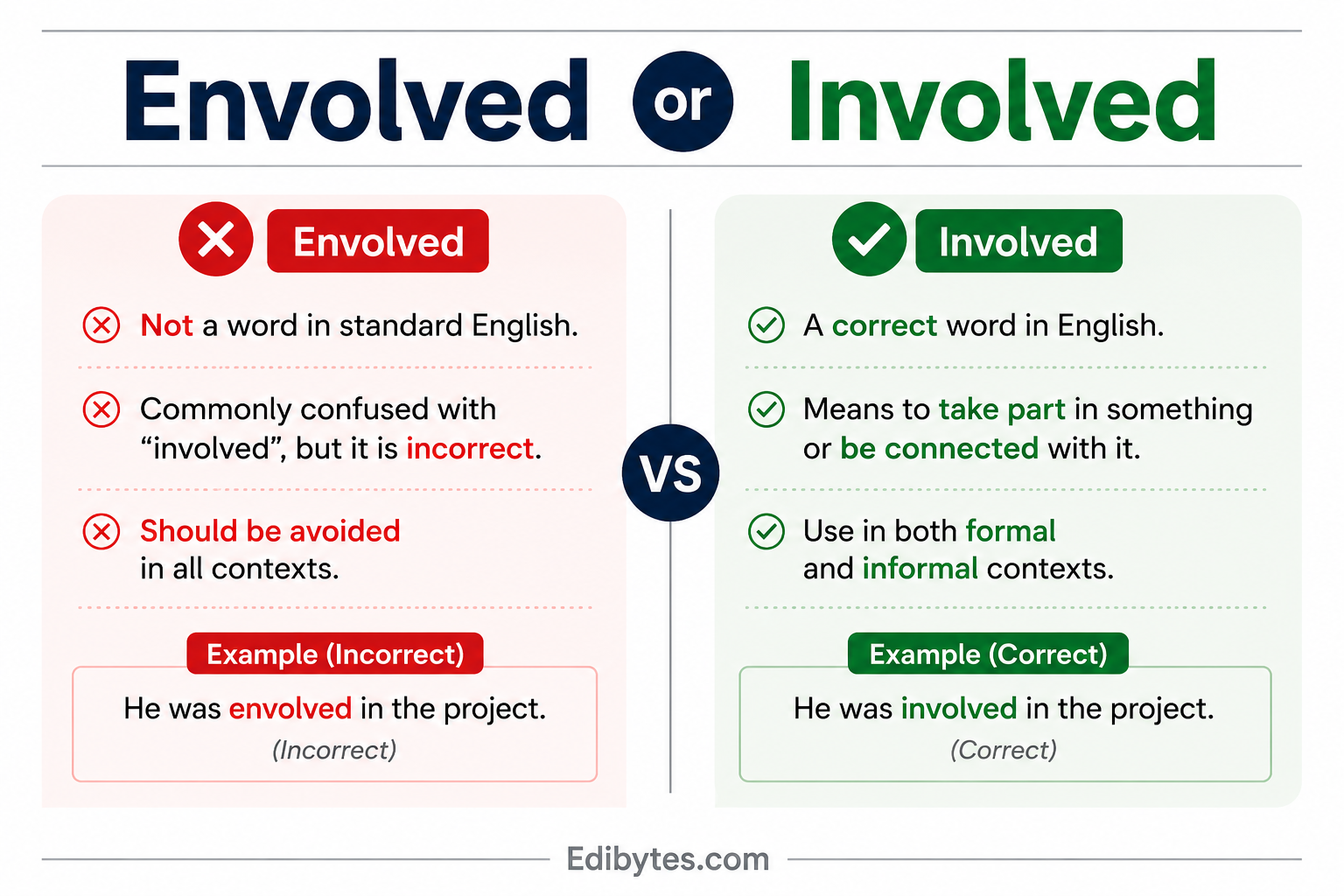
The correct spelling is involved.
Envolved is not a standard English word.
If you are involved in a project, involved in a relationship, or involved in an argument about whether “envolved” is somehow acceptable because everyone understood what you meant, the spelling is still involved.
And yes, I have typed envolved before, looked at it for several seconds, and thought, “That looks completely reasonable.”
It was not.
Key takeaways
To investigate how one missing letter became a full-blown spelling identity crisis, we spoke with Professor Oliver Pembroke, a reputed English teacher who has spent more than 30 years watching students confidently invent words and then defend them with remarkable passion.
“Professor, let’s get straight to it. Envolved or involved?”
Professor Pembroke: Involved. Next question.
Me: That was quick.
Professor Pembroke: You asked a spelling question, not for a parliamentary inquiry.
The correct word is involved.
For example:
- She was involved in the project.
- The police were involved in the investigation.
- I don’t want to get involved in their argument.
- He is emotionally involved.
There is no need to add an e at the beginning and create envolved, unless your goal is to make English teachers stare silently into the distance.
“But why do so many people write ‘envolved’?”
Professor Pembroke: Because English pronunciation has been running a long-term prank on humanity.
When people hear involved, especially in fast speech or different accents, the beginning can sound less clear than the spelling suggests. The brain then does what the brain loves doing. It fills in the missing information with confidence.
And confidence is dangerous.
You can be completely wrong and still type envolved like you personally approved the Oxford English Dictionary.
“I have to admit, I’ve written ‘envolved’ before and it looked correct to me. Am I alone?”
Professor Pembroke: Absolutely not. That is what makes spelling mistakes so successful.
The word looks believable.
It has the right number of letters.
It has vowels.
It has a sophisticated little v in the middle.
It looks like something you would find in an important email from someone saying, “As per our previous discussion, I was deeply envolved in this matter.”
Unfortunately, English does not judge words based on whether they look expensive.
My personal experience with “envolved”
I have had those moments where I type a word, stare at it, and suddenly lose all trust in my own education.
Involved.
Looks correct.
Envolved.
Also somehow looks correct.
Then you look at both for so long that involved starts looking suspicious too.
At that point, the spelling problem is no longer the problem.
You have simply entered what I like to call the grammatical void, where you have typed the same word repeatedly and now believe language itself may have been invented yesterday.
So naturally, you Google it.
And that is probably how many people end up searching:
envolved or involved
Google, meanwhile, has seen this question approximately a million times and is probably thinking, “Yes. Still involved.”
“Is ‘envolved’ ever correct in English?”
Professor Pembroke: Not in standard English.
If you are writing normal English, whether it is an article, email, assignment, LinkedIn post, or a message explaining why you were definitely not involved in whatever happened, use involved.
Me: What if I have already sent “envolved” to my boss?
Professor Pembroke: Then congratulations. You are now involved in a different problem.
“Can you explain the easiest way to remember it?”
Professor Pembroke: Start with the base word: involve.
If the verb is involve, then the past tense and past participle are involved.
Simple.
Involve → involved
Not:
Envolve → envolved
Because envolve is not standing quietly in the background waiting to become a real English word.
“What does ‘involved’ actually mean?”
Professor Pembroke: It depends on the sentence.
You can use involved to mean:
Taking part in something
She was involved in the campaign.
Being connected to something
Several companies were involved in the project.
Being in a complicated situation
This is more involved than I expected.
Having a romantic or emotional connection
They became involved.
English, as always, decided one word should have several jobs because apparently giving words one responsibility each would have been too organized.
“What about ‘involved with’ and ‘involved in’? Are both correct?”
Professor Pembroke: Yes, but they are often used differently.
Involved in
Usually means participating in or being connected to an activity or situation.
She is involved in marketing.
He was involved in the investigation.
Involved with
Can mean connected with a person, organization, or sometimes a romantic relationship.
She is involved with the company.
Are they involved with each other?
So if you say:
I am involved in SEO.
That sounds professional.
If you say:
I am involved with SEO.
It sounds like you and search engine optimization may be seeing each other.
“Is this just a typo, or should people actually care?”
Professor Pembroke: It depends.
If you accidentally type envolved in a WhatsApp message, nobody is launching an investigation.
But if you repeatedly use it in professional writing, articles, applications, or educational content, people may notice.
And the annoying thing about spelling mistakes is that readers often remember them more than the actual point you were making.
You could write 2,000 brilliant words about a complicated subject, but someone will still comment:
“Actually, it’s involved.”
And suddenly that becomes the entire meeting.
“So autocorrect can save us?”
Professor Pembroke: Sometimes.
Autocorrect is like that friend who occasionally saves your life and occasionally sends your mother a message saying, “I am feeling incredibly horny.”
Useful, but never trusted completely.
Spellcheck is better than nothing. But the easiest trick is still to remember the base word:
INVOLVE
Therefore:
INVOLVED
The in was there from the beginning. Do not replace it with an en just because the word sounded mysterious at 2 a.m.
“What are some common examples?”
Professor Pembroke: Glad you asked. Let us give people something they can copy without accidentally creating another spelling crisis.
- I was involved in the discussion.
- She is heavily involved in the business.
- Several people were involved in the decision.
- This process is more involved than it looks.
- He didn’t want to get involved.
- The company was involved with several charities.
And not:
- I was envolved in the discussion.
- She was heavily envolved.
- Everyone was somehow envolved.
Unless you are intentionally writing a character who cannot spell involved, in which case, congratulations, you have finally found a legitimate use for it.
“Final verdict?”
Professor Pembroke: Involved. Always involved.
If you remember nothing else from this interview, remember this:
You can be involved in a project. You can be involved in an argument. You can be involved in a relationship. But you should not be envolved in English.
And honestly, I think that is enough involvement for one day.
The final answer, before anyone searches it again
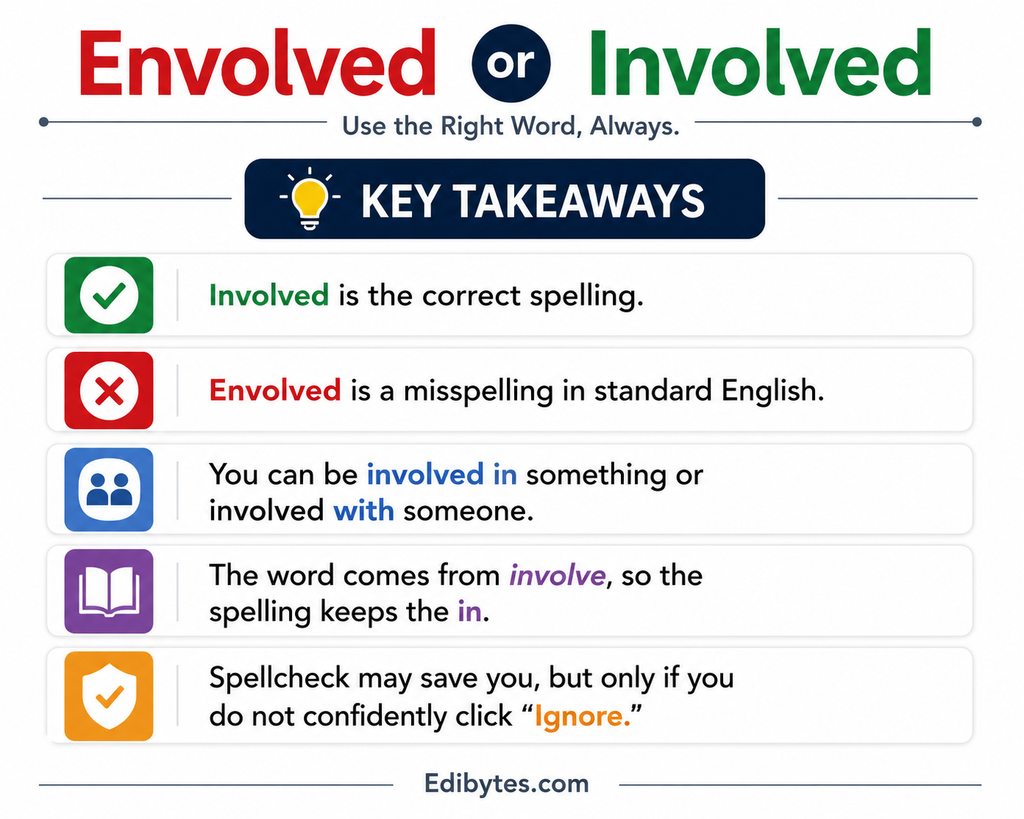
Involved is the correct spelling.
Envolved is a misspelling in standard English.
So the next time you type envolved, stop, take a breath, add the in, and move on with your life.
Because there are already enough things to get involved in.