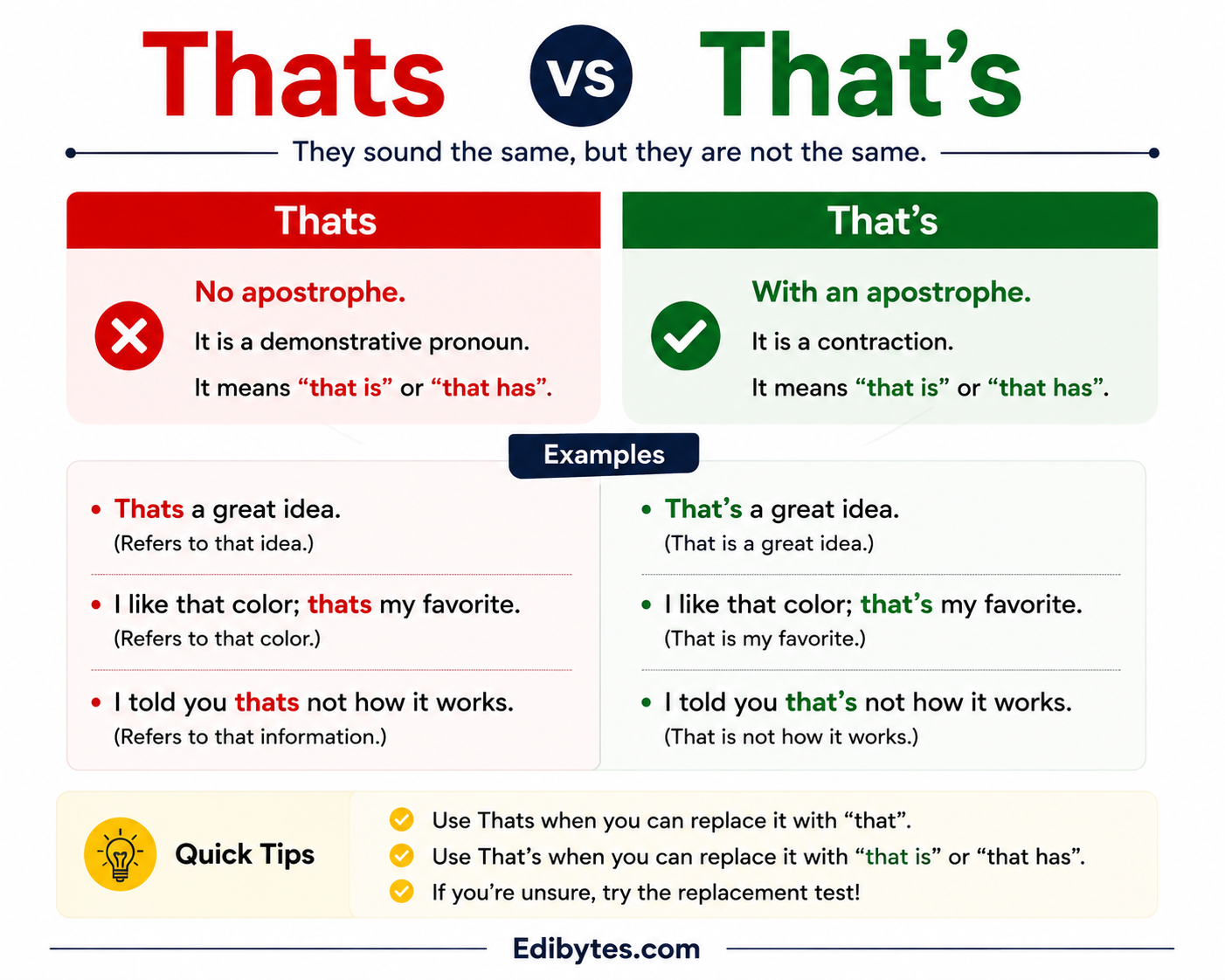
“That’s” is correct when you mean “that is” or “that has.”
“Thats” without an apostrophe is usually incorrect in standard English.
For example:
- That’s my car. = That is my car.
- That’s been a problem for years. = That has been a problem for years.
- Thats my car. = Your English teacher has quietly closed their laptop.
Simple, right?
Apparently not.
Because somewhere between typing quickly, arguing in YouTube comments, writing LinkedIn posts, and confidently correcting other people’s grammar, the apostrophe in that’s has become optional in the minds of many people.
To investigate this, we spoke with Professor Julian Penwright, a reputed English teacher, grammar enthusiast, and a man who reportedly keeps an emergency apostrophe in his wallet.
Key Takeaways
- That’s is a contraction of that is or that has.
- Thats is generally not correct in standard English.
- If you can replace that’s with that is or that has, use the apostrophe.
- Apostrophes are small, but apparently powerful enough to ruin comment sections.
- Writing “thats” by accident is not the end of civilization. Repeating it after reading this article might be.
Interview With Professor Julian Penwright
Q: Professor, let’s get straight to it. Is it “thats” or “that’s”?
Professor Penwright: That’s. With an apostrophe.
And before anyone says, “But everybody understands what I mean,” yes, everybody also understands what a toddler means when they point at a biscuit and scream. Communication is not the only goal here.
That’s is a contraction. The apostrophe is doing actual work. It replaces missing letters.
That’s = that is
That’s = that has
“Thats,” on the other hand, is what happens when the apostrophe misses its flight.
Q: So when exactly does “that’s” mean “that is”?
Professor Penwright: Most of the time, it is very easy.
Take this sentence:
That’s a great idea.
Expand it:
That is a great idea.
Still works perfectly.
Another example:
That’s why I called you.
Becomes:
That is why I called you.
Again, perfect.
If you can replace that’s with that is, congratulations. The apostrophe survives another day.
Q: And when does “that’s” mean “that has”?
Professor Penwright: When it is followed by a past participle.
For example:
That’s been happening for years.
That expands to:
That has been happening for years.
Or:
That’s caused a lot of confusion.
Meaning:
That has caused a lot of confusion.
The apostrophe is not decorative. It is basically holding two words together and asking everyone to behave.
Q: So is “thats” ever correct?
Professor Penwright: In standard English writing, generally no.
You might see Thats as a surname, a username, a brand name, or something someone typed while their phone was at 2 percent battery and their patience was at 1 percent.
But if you’re writing:
Thats amazing.
The standard version is:
That’s amazing.
No debate. No committee meeting. No emergency LinkedIn poll required.
Q: Why do so many people write “thats” without the apostrophe?
Professor Penwright: Because English has trained people to fear apostrophes.
Think about it. We have:
- its
- it’s
- you’re
- your
- they’re
- their
- there
At some point, people look at all this and decide, “You know what? I reject punctuation entirely.”
I understand the emotional journey. I do not support the final decision.
From my own experience, I think this happens most when people are typing fast. You write a long post, answer ten messages, argue about something online, and suddenly that’s becomes thats.
The funny part is that the sentence may be completely understandable. Nobody is calling an emergency meeting because you forgot an apostrophe.
But grammar has this strange ability to make a tiny mistake look much bigger once someone points at it.
You can write 2,000 intelligent words, and someone will still comment:
“Actually, its that’s.”
And suddenly the entire discussion is no longer about your idea. It is about a tiny floating comma that betrayed you.
Q: Is the apostrophe in “that’s” really that important?
Professor Penwright: Grammatically, yes. Emotionally, perhaps we need to calm down.
A missing apostrophe does not mean the writer is unintelligent. It usually means they made a mistake, typed quickly, or their keyboard decided punctuation was a premium feature.
But in polished writing, the difference matters.
Compare:
Thats what I mean.
with:
That’s what I mean.
The second one is correct because it means:
That is what I mean.
The apostrophe tells the reader that letters have been removed.
Without it, you are basically asking the reader to do the paperwork.
Q: What’s the easiest trick for remembering whether to use “that’s”?
Professor Penwright: Use the replacement test.
Whenever you write that’s, mentally replace it with either:
- that is
- that has
If the sentence still makes sense, that’s is correct.
Example 1
That’s the problem.
Replace it:
That is the problem.
Works.
Example 2
That’s been difficult.
Replace it:
That has been difficult.
Works.
Example 3
Thats the problem.
Replace it with anything you like. The apostrophe is still missing.
This is probably the easiest grammar test in the English language. It requires no dictionary, no subscription, and no person on LinkedIn calling themselves a “communication thought leader.”
Q: Can you give us some common examples?
Professor Penwright: Gladly. I have been preparing for this moment since 1987.
Correct: “That’s”
- That’s my phone.
- That’s a terrible idea.
- That’s exactly what I said.
- That’s been happening all week.
- That’s caused a lot of problems.
- I think that’s enough for today.
Incorrect in standard English: “Thats”
- Thats my phone.
- Thats a terrible idea.
- Thats exactly what I said.
The correction is not complicated. Just invite the apostrophe back into the sentence.
Q: Is “that’s” the same as “that is” every single time?
Professor Penwright: No. Sometimes it means that has.
That is where people get confused, although the sentence usually gives it away.
For example:
That’s been my biggest problem.
You would not expand that as:
That is been my biggest problem.
That sounds like English was assembled from spare parts.
Instead:
That has been my biggest problem.
So remember:
That’s = that is OR that has.
The sentence decides which one.
Q: What about “that is” and “that’s”? Can I always use either?
Professor Penwright: Grammatically, often yes, but the tone can be different.
That is sounds slightly more formal or emphatic.
That is exactly what I mean.
That’s sounds more natural and conversational.
That’s exactly what I mean.
Neither sentence needs to call the police. Choose based on how formal you want to sound.
Q: Why does this tiny mistake get so much attention online?
Professor Penwright: Because the internet has given everyone two things: a keyboard and confidence.
You can post an intelligent opinion about technology, politics, business, science, or society. Someone will scroll past all of it, find “thats”, and write:
“You mean THAT’S.”
Congratulations. The conversation is now over. The apostrophe has won.
Honestly, I have seen people spend more energy correcting a missing apostrophe than the original writer spent researching the entire article.
Grammar is important. But occasionally we must ask ourselves an important question:
Are we improving the sentence, or are we just enjoying the opportunity to be right?
Q: What would you say to someone who keeps writing “thats”?
Professor Penwright: I would say, first of all, relax.
This is one of the easiest mistakes to fix.
Just remember:
If you mean “that is” or “that has,” write “that’s.”
That’s it.
Well, technically, that’s also a contraction.
Look at us learning things.
Q: Final verdict. “Thats” vs “That’s.” Which one wins?
Professor Penwright: That’s, easily.
Not because it looks more sophisticated. Not because grammar teachers need another reason to feel powerful.
It wins because it is the correct standard form when you mean that is or that has.
So the next time you’re typing:
Thats crazy.
Stop.
Add the apostrophe.
Write:
That’s crazy.
And move on with your life.
There are bigger problems in the world.
For example, its vs it’s.
Professor Penwright declined to discuss that subject without legal representation.
Final Answer
If you are asking “Thats vs That’s, which is correct?”, the answer is simple:
Use “that’s” when you mean “that is” or “that has.”
Examples:
- That’s funny. = That is funny.
- That’s been difficult. = That has been difficult.
“Thats” without an apostrophe is generally incorrect in standard English.
One tiny apostrophe. One huge opportunity to avoid being corrected by someone who ignored everything else you wrote.