There are some questions that change lives.
Who am I?
Why are we here?
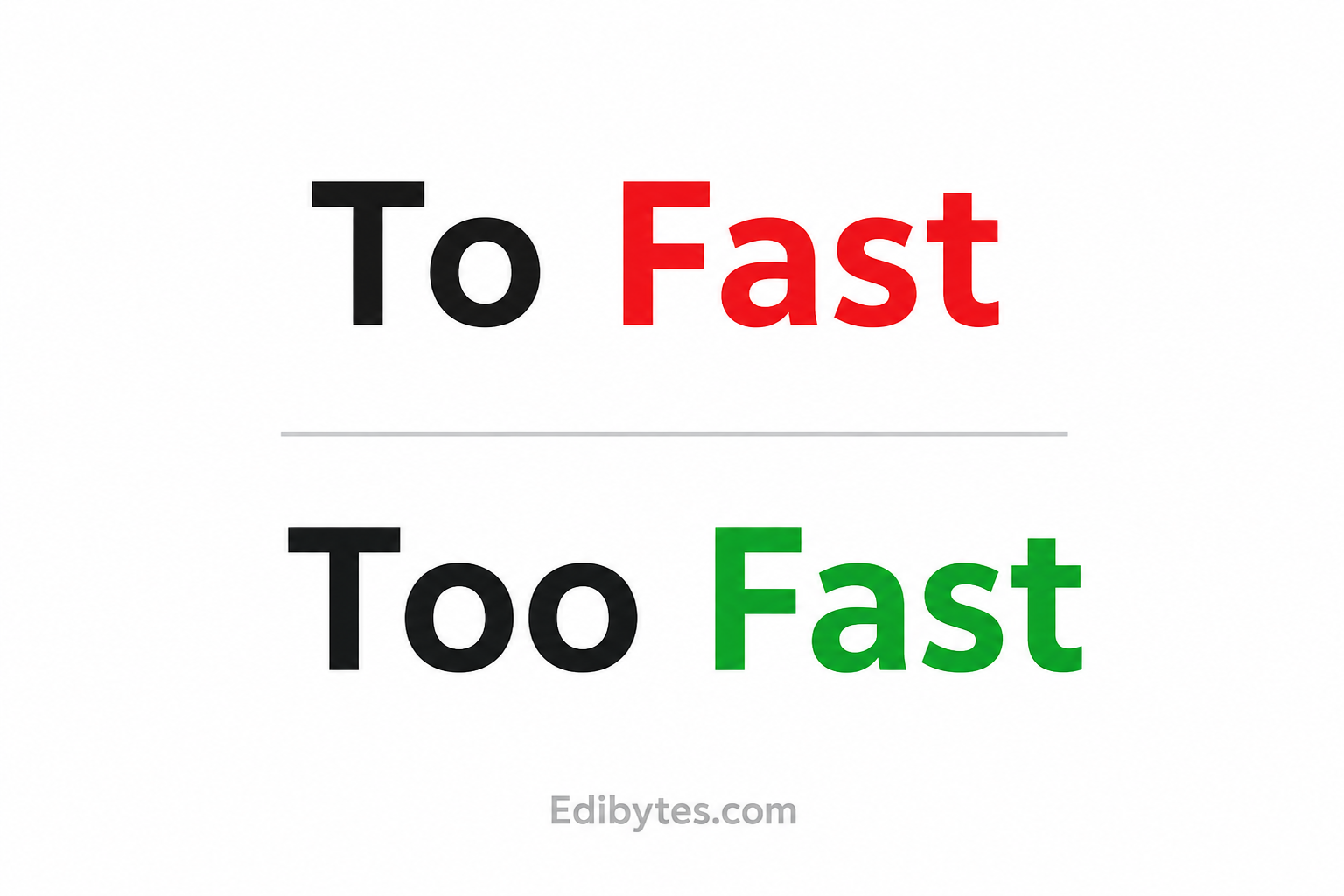
And, perhaps most importantly, is it “to fast” or “too fast”?
To settle the matter once and for all, we sat down with Professor Richard Proper, the internationally celebrated authority on English grammar, speed-related confusion, and correcting people in group chats.
Q: Professor, let’s start with the obvious. Is it “to fast” or “too fast”?
Professor Richard Proper:
It depends on what you’re trying to say.
If you’re talking about something happening at excessive speed, it’s “too fast.”
For example, “You’re driving too fast.”
If you’re talking about going somewhere or doing something, you might need “to”, as in, “I went to the store.”
So if someone writes, “This car is going to fast,” I immediately know two things. One, the car may be moving quickly. Two, the grammar needs roadside assistance.
Q: So “too fast” is correct when we mean excessively fast?
Professor:
Exactly.
“Too” means more than necessary, desirable, or acceptable.
“Fast” describes speed.
Put them together and you have “too fast.”
It’s a beautiful little partnership.
Unlike some partnerships I see on Facebook where people write, “I am too fast to catch.” I don’t know what that means, but I respect the confidence.
Q: Why do people confuse “to” and “too” so often?
Professor:
Because English enjoys watching people suffer.
There are three words involved: “to,” “too,” and “two.”
One indicates direction or forms part of an infinitive. One means also or excessively. One means the number 2.
Same pronunciation in many situations, completely different jobs.
It’s basically the English language saying, “Good luck.”
Q: Can you give us an easy way to remember the difference?
Professor:
Certainly.
If you mean excessively, use “too.”
“She talks too much.”
“He runs too fast.”
“This article is too long.”
Although I personally believe no article is too long if I’m the one being interviewed.
If you’re talking about direction or an infinitive, it’s generally “to.”
“I want to go to London.”
“I need to sleep.”
“I have to explain this distinction for the 400th time.”
Q: What about the phrase “I am going too fast”?
Professor:
Correct.
“I am going too fast” means you’re moving at a speed that’s greater than appropriate.
“I am going to fast” means something very different.
It sounds like you’re about to begin fasting.
So imagine someone saying:
“I am going to fast.”
And the other person asks:
“For how long?”
“Until I reach the highway.”
At that point, we have bigger problems than grammar.
Q: What about “I want to fast”?
Professor:
That’s correct if you mean you want to abstain from food for a period of time.
“I want to fast.”
But if you say, “I want to fast to the airport,” you’ve accidentally created a very confusing fitness challenge.
Q: Is there a quick trick people can use when they’re unsure?
Professor:
Yes.
Ask yourself what you mean.
If you mean excessively or additionally, think “too.”
If you mean direction, purpose, or the infinitive form, think “to.”
And if you mean the number 2, congratulations. You’ve found “two.”
English has provided three options and somehow we still manage to fight about them.
Q: What’s the most common mistake you see with “too fast”?
Professor:
People write “to fast” when they mean “too fast.”
For example:
“Why are you driving to fast?”
That sentence is essentially telling the driver that they’re driving in order to fast.
It’s not grammatically what they intended.
The correct sentence is:
“Why are you driving too fast?”
And frankly, if you’re typing that message while sitting in the passenger seat, perhaps stop texting and let the driver concentrate.
Q: Does autocorrect make things better or worse?
Professor:
Worse.
Autocorrect has enormous power and absolutely no accountability.
You can type something perfectly reasonable and suddenly your phone decides you meant something completely different.
Then you send it.
Then you reread it.
Then you spend six minutes wondering whether you can delete a message without looking suspicious.
Grammar mistakes are one thing. Autocorrect mistakes are personal.
Q: So if someone searches “to fast or too fast,” what should they remember?
Professor:
Remember this:
“Too fast” = excessively fast.
“To” = direction or part of an infinitive.
So:
“I’m driving too fast.” Correct.
“I want to drive.” Correct.
“I drove to the airport.” Correct.
“I drove too fast to the airport.” Also correct, although perhaps not ideal.
Q: Final question. Is there ever a situation where “to fast” is correct?
Professor:
Absolutely.
If “fast” is being used as a verb meaning to abstain from food, then “to fast” is perfectly correct.
For example:
“I decided to fast tomorrow.”
But if you’re describing speed, you almost certainly want “too fast” when you mean excessively fast.
And that’s the whole mystery.
Two tiny letters.
One extra “o.”
A remarkable amount of confusion.
Q: Any final words for people who still get it wrong?
Professor:
Yes.
Don’t be afraid of making mistakes.
But once someone tells you the difference between “to” and “too,” please don’t make the same mistake in the next sentence.
That’s not a grammar issue anymore.
That’s commitment.
And with that, Professor Proper left the room at a perfectly reasonable speed.
Not too fast.
And definitely not to fast.