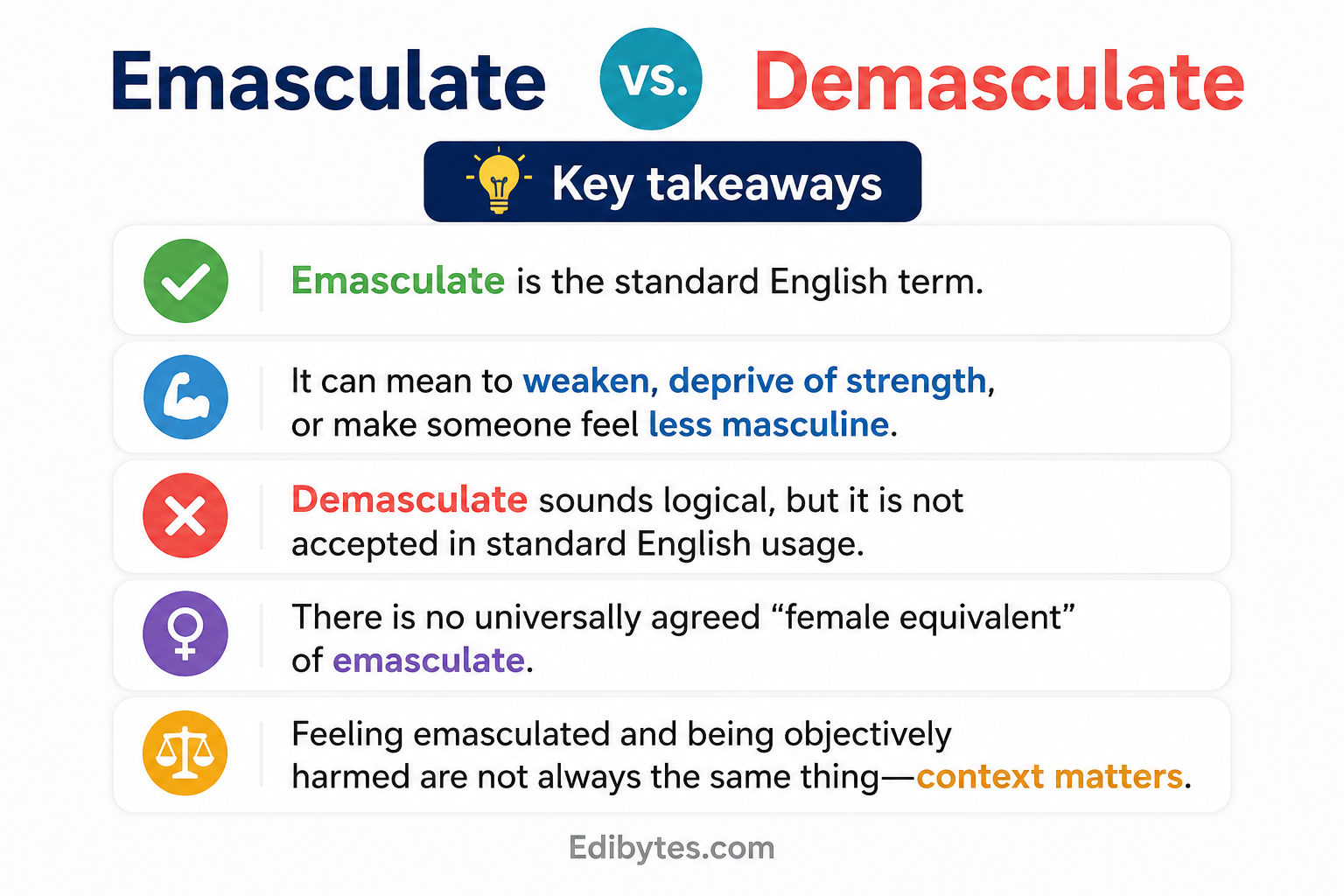
The correct word is emasculate. Demasculate is generally considered a nonstandard or mistaken formation and is not the word you want in formal or academic writing.
Key takeaways
- Emasculate is the standard English term.
- It can mean to weaken, deprive of strength, or make someone feel less masculine.
- Demasculate sounds logical, but it is not accepted in standard English usage.
- There is no universally agreed “female equivalent” of emasculate.
- Feeling emasculated and being objectively harmed are not always the same thing-context matters.
A Conversation With Dr. Adrian Wells, Linguistics Consultant
Doug Chernoff: Let’s settle this immediately. Is the correct word demasculate or emasculate?
Dr. Adrian Wells: The correct term is emasculate.
If you’re writing anything formal-an article, essay, report, or even a strongly worded email-you should use emasculate.
Demasculate is a form that people intuitively create because English often uses the prefix de- to indicate removal or reversal. We see it in words like devalue, deactivate, and dehumanize. So it feels natural to assume demasculate should mean “to remove masculinity.”
Unfortunately, English does not always reward logical assumptions. It rewards historical usage.
Why do people say “demasculate” if it’s incorrect?
Doug Chernoff: If “emasculate” is correct, why does “demasculate” keep appearing?
Dr. Adrian Wells: Because it sounds structurally plausible.
English speakers are pattern-driven. When they see a familiar prefix like de-, they apply it broadly. The issue is that not every word in English is built from predictable components.
The word emasculate already exists with its own historical development. It does not require a “de-” version.
So while people may understand what “demasculate” is trying to express, it is not considered standard usage in academic, professional, or edited writing.
What does “emasculate” actually mean?
Doug Chernoff: What does it mean when someone says a man was “emasculated”?
Dr. Adrian Wells: In modern usage, emasculate typically means to weaken someone’s sense of masculinity, power, or confidence.
For example:
“He felt emasculated after being publicly corrected in front of his team.”
This does not necessarily refer to physical harm. It is usually psychological or social in meaning.
However, it is important to be precise: not every uncomfortable or embarrassing experience is “emasculating.” The term is often overused in casual speech.
Does emasculation always involve women or relationships?
Doug Chernoff: People often say a woman “emasculated” a man. Is that accurate?
Dr. Adrian Wells: Not inherently.
A person may feel emasculated in many contexts workplace criticism, social embarrassment, failure, or comparison with others. It is not limited to romantic relationships or interactions with women.
For example:
- A manager publicly criticizing an employee
- A peer outperforming someone in a competitive setting
- A failure in a skill someone strongly identifies with
These situations may lead to feelings of inadequacy, but the word “emasculate” should be used carefully, not as a blanket label for discomfort.
Is it “emasculating” or “emasculating”?
Doug Chernoff: A surprisingly common question: is it “emasculating” or “emasculating”?
Dr. Adrian Wells: They are identical. There is no variation in spelling.
The correct form is:
E-M-A-S-C-U-L-A-T-I-N-G
Any confusion here is usually the result of autocorrect or search engine repetition rather than actual linguistic variation.
What is “demasculate,” linguistically speaking?
Doug Chernoff: So what exactly is “demasculate”?
Dr. Adrian Wells: In standard English, demasculate is not recognized as a formal word. It is best described as a nonstandard or analogical formation.
It appears in informal writing because speakers attempt to apply familiar morphological rules. Sometimes such formations eventually become accepted over time but in this case, that has not happened.
At present, emasculate remains the correct and established term.
Is there a female equivalent of emasculation?
Doug Chernoff: Is there a direct female equivalent?
Dr. Adrian Wells: Not a perfect one-to-one equivalent.
Depending on context, alternatives might include:
- humiliated
- belittled
- undermined
- disempowered
- demeaned
- made to feel less confident or less valued
English does not consistently mirror gendered emotional terms. It tends to describe the experience rather than create symmetrical vocabulary pairs.
How does someone who feels “emasculated” typically behave?
Doug Chernoff: Are there recognizable behavioral patterns?
Dr. Adrian Wells: There is no fixed behavioral profile.
However, someone experiencing feelings described as “emasculation” may:
- become defensive
- withdraw socially
- overcompensate in behavior
- display frustration or irritability
- seek validation or reassurance
It is important to emphasize that these are emotional responses, not diagnostic categories. The term itself is subjective and context-dependent.
Why does the term exist at all?
Doug Chernoff: Where does the concept come from?
Dr. Adrian Wells: Historically, emasculate had a literal meaning related to castration. Over time, it evolved into a metaphorical term describing loss of strength, authority, or perceived masculinity.
Modern usage is almost entirely figurative, though the historical root still influences its emotional weight.
How should someone respond if they feel “emasculated”?
Doug Chernoff: Any practical advice?
Dr. Adrian Wells: The first step is interpretation.
Ask:
- Was I actually disrespected or harmed?
- Or did I simply experience embarrassment, correction, or failure?
Not every uncomfortable experience reflects a loss of identity or status. Sometimes it reflects normal human vulnerability.
A healthier perspective is to separate self-worth from momentary setbacks or comparisons.
What about religious or historical references?
Doug Chernoff: Does the Bible or historical texts mention emasculation?
Dr. Adrian Wells: The Bible does not use the modern psychological framing of “feeling emasculated,” but it does reference eunuchs and related historical practices in several passages, including discussions in texts such as Matthew 19:12.
These references are contextual and historical, not psychological commentary in the modern sense.
It is important not to project contemporary emotional meanings onto ancient texts.
Final verdict: should you ever use “demasculate”?
Doug Chernoff: Final question can “demasculate” ever be used?
Dr. Adrian Wells: In standard English writing, no.
While language does evolve, emasculate is the accepted and correct form, and “demasculate” remains nonstandard.
Quick reference
| Question | Answer |
|---|---|
| Correct word? | Emasculate |
| Is “demasculate” valid? | Nonstandard |
| Meaning of emasculate? | To weaken or diminish confidence/masculinity |
| Female equivalent? | No direct equivalent |
| Is it always gender-related? | No, context-dependent |
Closing note
Language is not always intuitive. It often preserves history rather than logic.
So while “demasculate” may feel like it should exist, English has already made its decision.
And in this case, the language is quite firm:
Emasculate is the word that stayed.