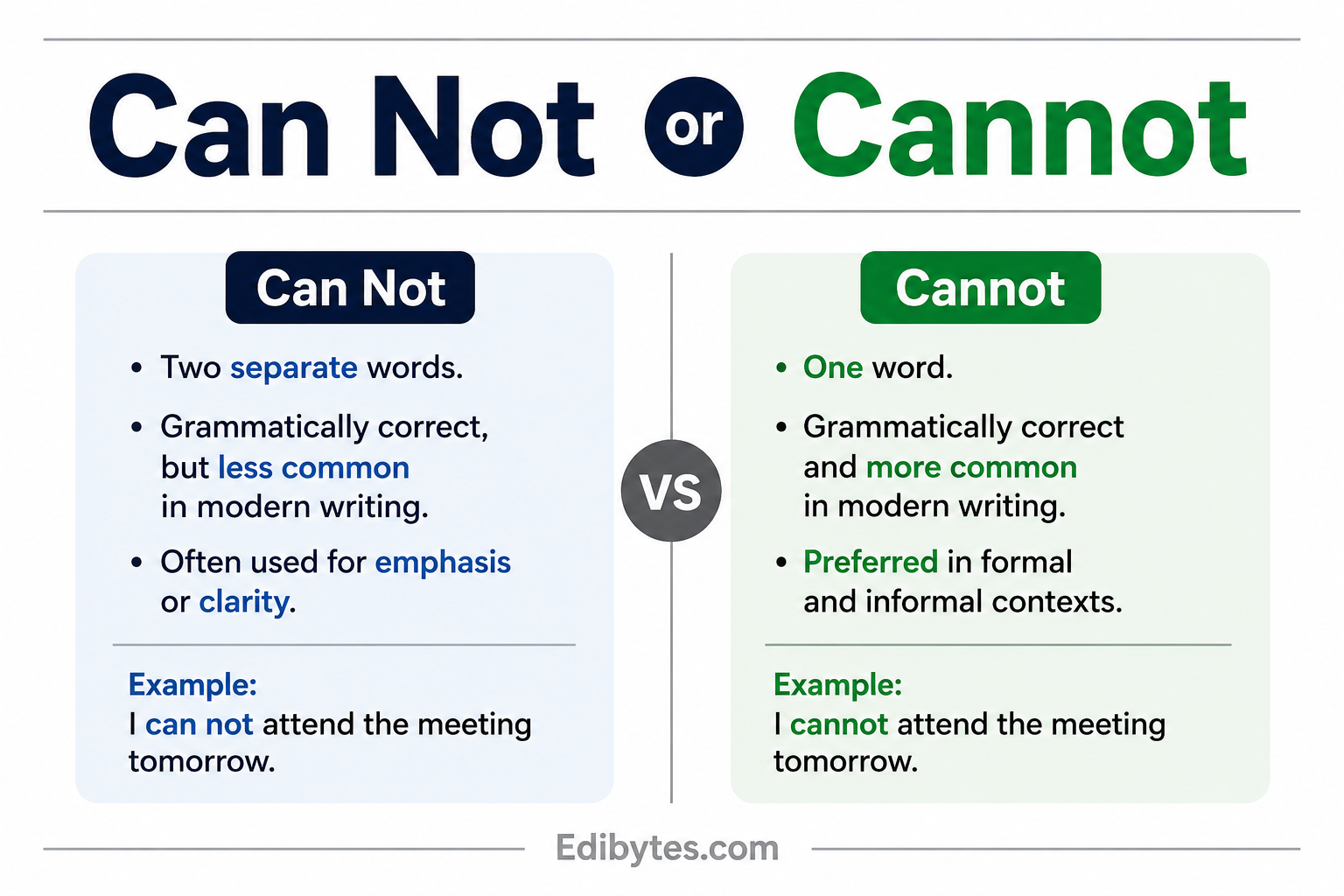
Short answer: use “cannot” almost every time.
Yes, the answer is that simple.
Cannot is the standard one-word spelling when you mean not able to or not permitted to do something.
I cannot swim.
You cannot park here.
I cannot believe we are having a national emergency over one missing space.
Can not does exist, but it is used in more specific situations where not belongs separately with another part of the sentence.
You can choose to go, or you can not go.
Although, honestly, in normal writing, I would probably rewrite that sentence as:
You can choose to go, or you can choose not to go.
Because apparently English was not complicated enough already.
Key Takeaways
- Cannot is usually the correct spelling.
- Can’t is the contraction of cannot.
- Can’t is one word, despite looking like two words that got into an argument and lost the space.
- Can not is possible, but only in certain sentence structures.
- Cannot is used in both British and American English.
- Can’t able is not grammatically correct.
- Cannot not is grammatically possible and means you are unable to avoid doing something.
To settle this once and for all, I decided to interview someone with years of experience teaching English, correcting sentences, and watching perfectly intelligent people stare at the words can not and cannot as if they were trying to solve quantum physics.
Unfortunately for everyone involved, that person was me.
Interview: An English Teacher Explains Why One Space Has Caused So Much Trouble
Q: Is the word “cannot” correct?
Adam Keith English Teacher: Yes. Absolutely. Completely. No appeals process.
Cannot is a correct English word. In fact, it is usually the spelling you want.
If you mean that someone is unable to do something, or is not allowed to do something, use cannot.
I cannot drive.
You cannot enter this room.
We cannot keep pretending that “can not” and “cannot” are interchangeable every single time.
As an English teacher, I have seen students hesitate for several minutes before writing cannot, as though somewhere a grammar police officer is waiting to arrest them.
Relax. Write cannot.
Q: Can not or cannot in British English?
Adam Keith English Teacher: Both British English and American English use cannot.
This is not one of those situations where Britain says one thing, America says another thing, and everyone spends 300 years arguing about a letter.
For example:
British English:
I cannot attend the meeting.
American English:
I cannot attend the meeting.
Look at that. International cooperation. A beautiful moment.
The contraction can’t is also used in both.
There may be differences in pronunciation. Depending on the accent, can’t can sound slightly different. But the grammar itself is not staging a Britain versus America boxing match.
Q: What does “I cannot” mean?
Adam Keith English Teacher: It means I am not able to, I am unable to, or sometimes I am not willing to accept or believe something.
For example:
I cannot swim.
Meaning: I am unable to swim.
I cannot come to the party.
Meaning: I am unable to come.
I cannot believe you used Comic Sans in a business presentation.
Meaning: I have experienced emotional damage.
The exact meaning depends on the sentence, but the basic idea is that something is impossible, not allowed, or simply not happening.
Q: How do you use can or cannot?
Adam Keith English Teacher: Can is generally used to talk about ability, possibility, or permission.
Ability
I can speak English.
She can drive.
Possibility
It can get very cold here.
Permission
You can leave early today.
Then we have cannot, which gives us the negative form.
I cannot speak Japanese.
She cannot drive.
You cannot leave yet.
So, very simply:
Can = able to / allowed to / possible
Cannot = not able to / not allowed to / not possible
I have spent years teaching this, and yet somewhere, every day, someone types:
I can’t able to come.
And somewhere in the distance, an English teacher quietly closes their laptop.
Q: What is cannot vs can not?
Adam Keith English Teacher: Here is where the tiny space starts charging rent.
Cannot
Use cannot when you simply mean not able to or not allowed to.
I cannot understand this.
You cannot enter.
We cannot continue like this.
Can not
Use can not when not is connected to something that follows, often when you are talking about choosing not to do something.
For example:
You can go, or you can not go.
This is grammatically possible, although it sounds awkward.
A more natural version would be:
You can go, or you can choose not to go.
So if you are writing an ordinary negative sentence, choose cannot.
Think of can not as the special guest who occasionally appears but does not live there.
Q: What does “cannot” mean?
Adam Keith English Teacher: Cannot means that something is not possible, not permitted, or beyond someone’s ability.
For example:
I cannot lift that box.
Not physically able.
You cannot smoke here.
Not permitted.
This cannot be true.
The speaker believes it is impossible.
It can also be used for dramatic effect, which English speakers absolutely love.
I cannot even.
Technically, the sentence has abandoned us halfway through. Emotionally, however, everyone understands.
Q: Is “cannot” or “can not” the correct spelling?
Adam Keith English Teacher: For most sentences, cannot is the correct spelling.
If you are unsure, write cannot.
Seriously.
You will be correct most of the time.
I cannot attend.
He cannot understand.
They cannot enter.
The separate spelling can not is only needed when the sentence specifically requires not to stay separate.
If you have to spend 20 minutes debating whether to use can not, there is a good chance cannot is what you wanted.
Q: What does “cannot not” mean?
Adam Keith English Teacher: Ah, yes. The moment English looks directly at you and says, “Let’s make this interesting.”
Cannot not means that you are unable to avoid doing something.
For example:
I cannot not laugh.
Meaning:
I cannot avoid laughing.
Or:
I have to laugh.
Another example:
She cannot not notice the mistake.
Meaning:
She cannot avoid noticing it.
It sounds like a double negative party, but the meaning is actually straightforward once you slow down.
Cannot not do something = cannot avoid doing it.
I cannot not check my phone.
Congratulations. You are checking your phone.
Q: Is can’t two words?
Adam Keith English Teacher: No.
Can’t is one word.
It is a contraction of cannot.
Cannot → can’t
The apostrophe replaces letters that have been removed.
So:
I can’t swim.
is a shorter, more conversational version of:
I cannot swim.
Please do not write:
I can ‘t swim.
That is not a contraction. That is a grammatical crime scene.
Q: What does “can’t” mean?
Adam Keith English Teacher: Can’t means cannot.
It can express inability:
I can’t swim.
It can express lack of permission:
You can’t park here.
It can express disbelief:
That can’t be true.
And it can express the universal human experience of being too tired to function:
I can’t deal with this today.
Grammatically simple. Emotionally versatile.
Q: Is “can’t able” grammatically correct?
Adam Keith English Teacher: No. Please don’t do this to the English language.
Can’t already means cannot.
Able is another way of expressing ability.
So when you say:
I can’t able to do it.
you are essentially trying to put two grammatical systems into one sentence and hoping they become friends.
Instead, say either:
I can’t do it.
or:
I am not able to do it.
Both are correct.
Similarly:
I can’t able to come. ❌
Use:
I can’t come. ✅
or:
I am not able to come. ✅
Pick one. Let the sentence breathe.
Q: Is can’t a single word?
Adam Keith English Teacher: Yes. Can’t is a single word.
It is a contraction.
Other examples include:
do not → don’t
will not → won’t
is not → isn’t
cannot → can’t
And before anyone asks, no, can not does not become can’t by simply throwing an apostrophe at the space.
English contractions have rules. They may occasionally appear to have been invented during a thunderstorm, but there are rules.
So Why Do People Get “Can Not” and “Cannot” Wrong?
Adam Keith English Teacher: Because English likes to take a simple idea and hide one small exception behind it.
Most people learn:
can + not = cannot
Then one day they encounter can not written separately and suddenly everything they thought they knew collapses.
But the solution is much easier than people make it.
If you mean:
not able to
or:
not allowed to
use cannot.
I cannot go.
You cannot enter.
We cannot afford it.
If you are specifically constructing a sentence where someone has the option not to do something, then can not may make sense.
You can choose to participate, or you can choose not to participate.
And honestly, that rewritten version is usually clearer anyway.
Final Verdict From an English Teacher Who Has Seen Enough
If you came here looking for a simple answer, here it is again:
Use “cannot” as one word in almost every normal negative sentence.
Use can’t when you want the shorter, more conversational version.
Use can not only when not needs to remain separate because of the sentence structure.
And please, for the love of every English teacher who has ever corrected homework at midnight, do not write:
I can’t able to do this.
You can’t do it.
You are not able to do it.
But you absolutely cannot combine both and expect me not to notice.
Unfortunately, as an English teacher, I cannot not notice.
And that, right there, is why I need a holiday.